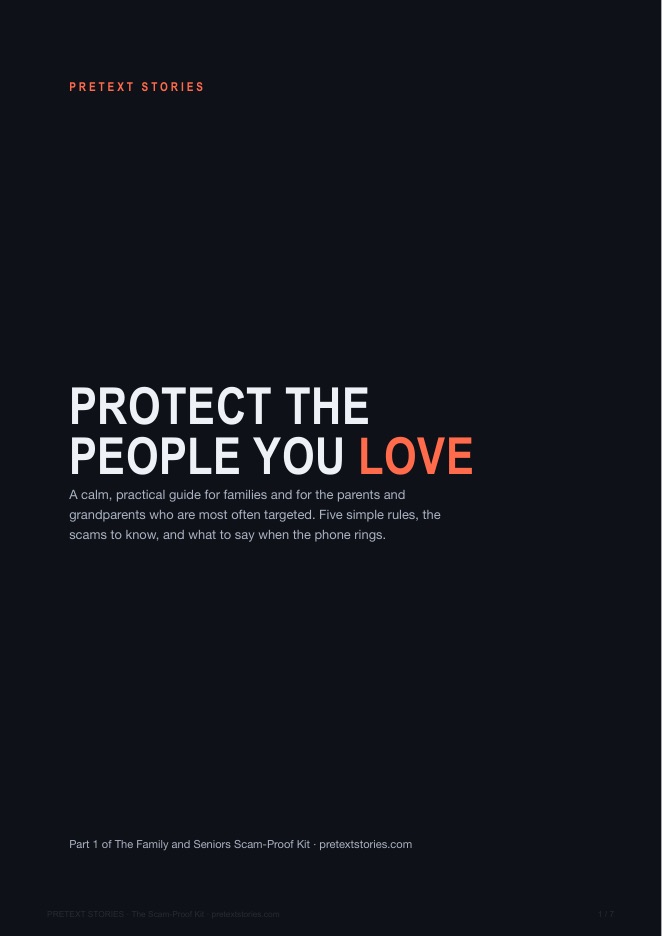
A calm, practical kit for families and for the parents and grandparents scammers target most. Five simple rules, eleven scams explained with official sources, big-print cards for the fridge and the phone, and a family code word everyone knows.
Know what to say when "the bank", "the government" or "your grandchild" calls
Set up phones, email and banking in about 30 minutes
Large-print cards and scripts for the people who need them most
Know exactly what to do in the first hour if a scam gets through
44 pages of guides11 scams, with official sourcesLarge-print cards and scriptsA Word family agreement
Why this matters
Scammers do not target people because they are foolish. They target people who are kind, trusting and busy, and they build a story that makes the quick, kind thing look right: your grandchild is in trouble, your bank is protecting you, a stranger needs your help.
The FBI's 2025 Internet Crime Report counts $7.748 billion in reported losses from people aged 60 and over in 2025, with an average loss of $38,500. These are reported losses, so the real number is likely higher. The best defence is not constant suspicion. It is a few simple rules and a few ready-made sentences, used every time.
What is inside
Part 1 · 7 pagesThe Family Guide
The five family rules, the four warning signs, how scammers think, how to set up a family code word, and how to talk to a parent without lecturing.
Part 2 · 14 pagesThe Scam Gallery
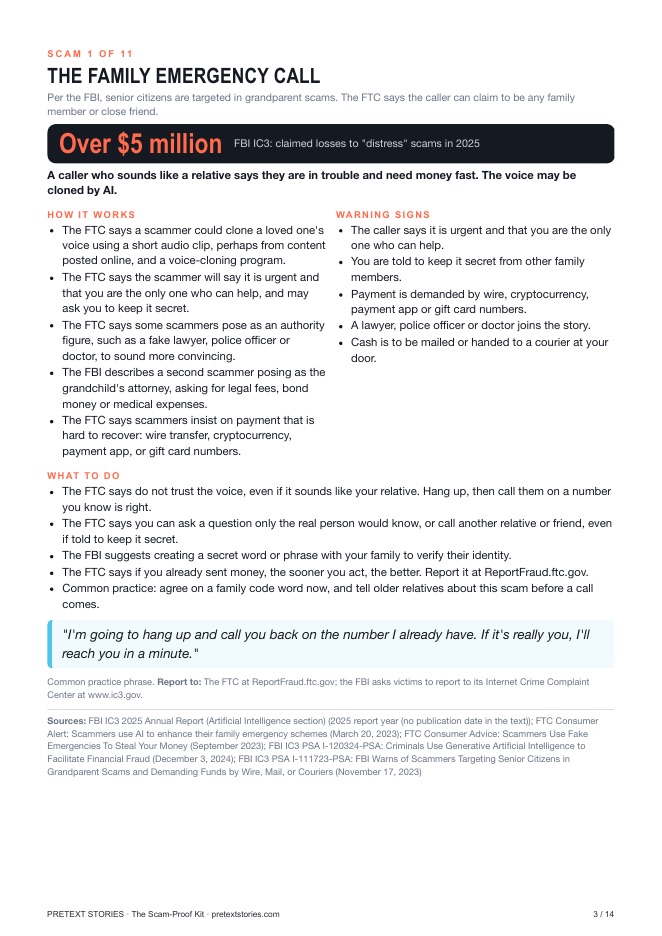
Eleven scams, one page each: how it works, warning signs, what to do, a sentence to say, who to report to, and the official sources. Plus the numbers, with the year next to every figure.
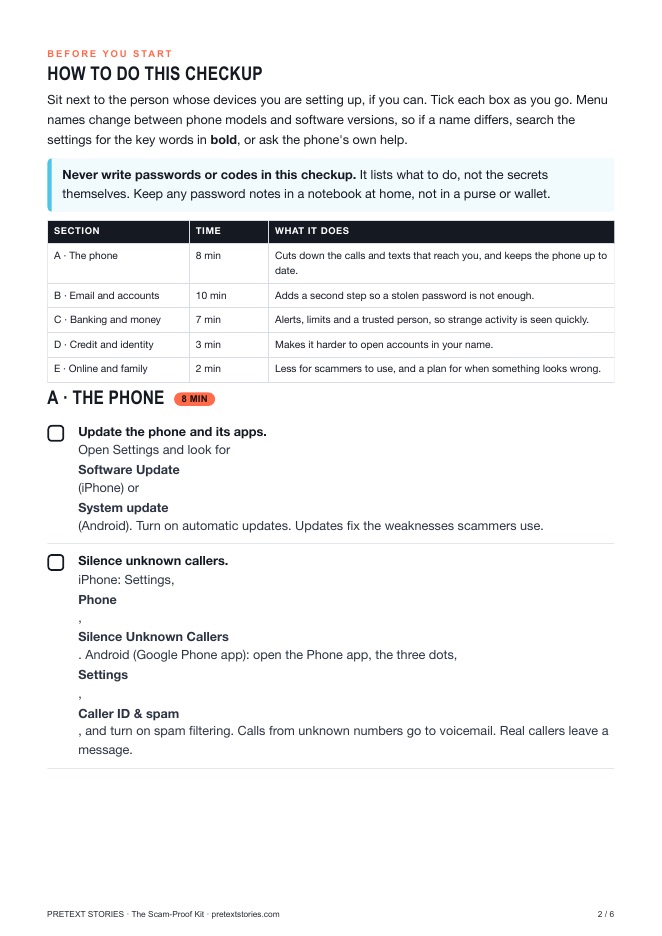
Part 3 · 6 pagesThe 30-Minute Checkup
Set up phones, email, banking and credit so most scams fail before they start: silence unknown callers, two-step sign-in, bank alerts, a credit freeze.
Part 4 · 6 pagesLarge-Print Cards and Scripts
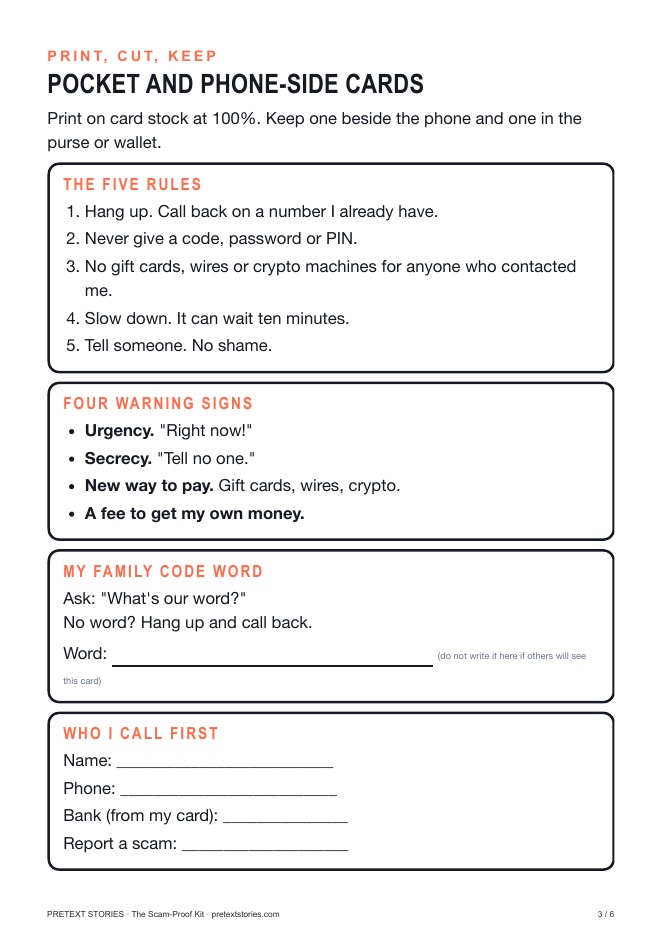
A fridge poster, pocket cards and nine word-for-word scripts in big type: what to say to the grandchild call, the bank call, the toll text, the wrong number.
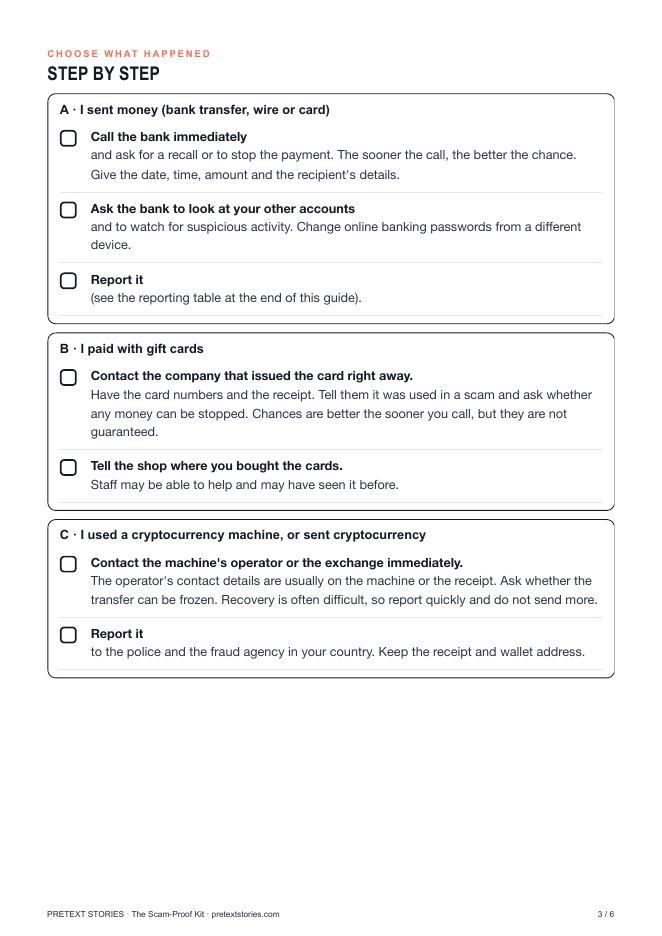
Part 5 · 6 pagesIf It Already Happened
The first hour after a scam, step by step, for each way money was sent, and how to support someone who was caught without blame.
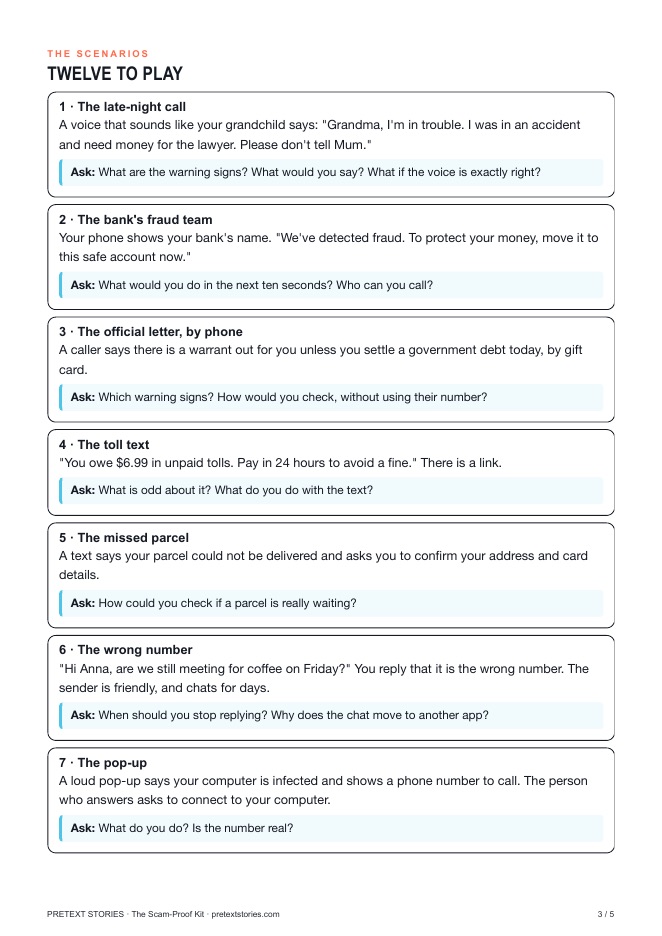
Part 6 · 5 pagesFamily Game Night
Twelve "what would you do?" scenarios with answers, for fifteen minutes around the table. Pairs with the free Check First game.
Part 7 · WordThe Family Safety Agreement
An editable one-page agreement: your code word rules, trusted circle, money rule and promise of no blame. Fill it in together and sign it.
A look inside
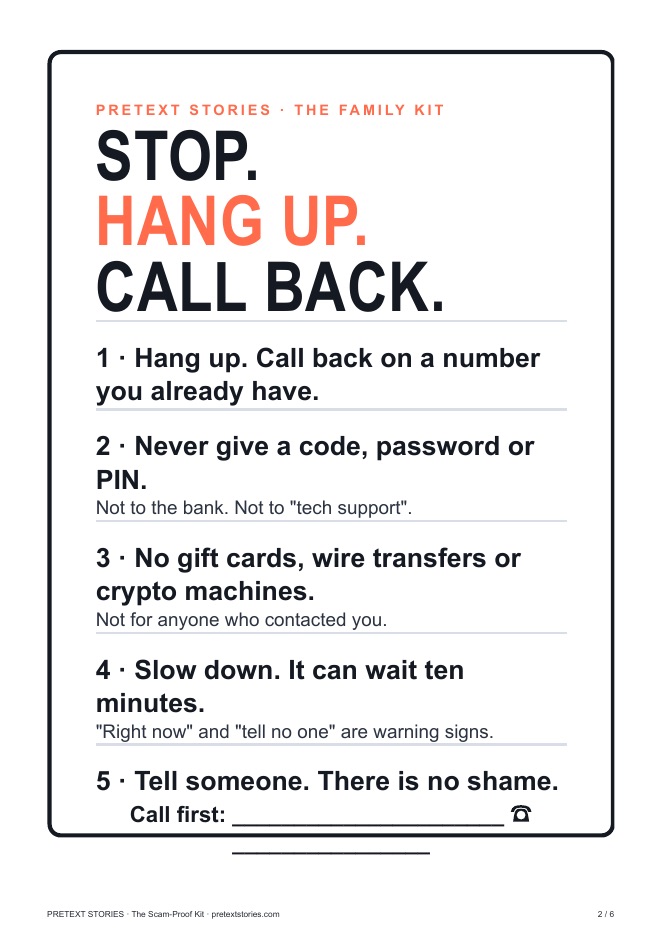
The Scam Gallery: how it works, warning signs, what to say, sources.A large-print fridge poster: "Stop. Hang up. Call back."Large-print pocket and phone-side cards.The 30-minute phone and account checkup.If It Already Happened: step by step, no blame.Family Game Night: scenarios and answers.
The Phantom Hacker (tech support to "safe account")
Fake toll and package texts
Crypto ATM and Bitcoin machine scams
The friendly wrong number (romance and investment)
The video call where everyone was fake
The call from "IT support"
The text that said "your login expires"
Each page cites the official document it comes from: the FTC, the FBI's Internet Crime Complaint Center, the Social Security Administration, the IRS and court filings. Allegations are labelled. No private individuals are named.
A fifteen-minute family plan
Minutes 0 to 3Share one story from the Scam Gallery. Ask: "Have you ever had a message like that?"
Minutes 3 to 8Go through the five rules. Hand out the cards. Say each "say this" line aloud once.
Minutes 8 to 12Choose the family code word. Write down who to call first.
Minutes 12 to 15Sign the Family Safety Agreement. Book the 30-minute checkup.
Is it for you?
It fits if you are
Worried about a parent or grandparent
A parent or grandparent who wants to be ready
Looking for simple rules and ready-made sentences
Someone who wants a calm plan, not fear
It is not
A security app or a call blocker
Legal, financial or professional advice
A guarantee that money can be recovered
Tied to any company. There are no affiliate links in it.
✓
14-day refund. If the kit is not useful to your family, email us within 14 days of buying and we will refund you in full. No questions asked.
The Family and Seniors Scam-Proof Kit
$14one-time · instant download
Seven parts, 44 pages and a Word family agreement. Print it, share it with your relatives, and have the conversation.
No. The guides are in plain language. The 30-minute checkup tells you which settings to look for, and says that menu names vary by phone. If something is unclear, a younger relative can help.
Is it written for seniors or for their families?
For both. Part 1 is for the whole family, Part 4 is printed in large type for the person who gets the calls, and Part 5 helps families support someone who has been scammed, without blame.
Where do the facts come from?
Public documents of government agencies and courts, such as the FTC, the FBI's Internet Crime Complaint Center, the Social Security Administration and the IRS. Each Scam Gallery page lists them, with dates, and every figure shows its year. Tips we write ourselves are labelled "Common practice".
I live outside the United States. Will it work?
The rules, scripts and checkups apply anywhere. Some official sources named in the Gallery are American, and the kit has blank lines for your own country's reporting agency and bank number. It is in English; an Arabic edition is planned.
Can I share it with relatives?
Yes, with your own family. Please do not resell it or post it publicly.
Will it stop every scam?
No. Nothing does. It makes the common ones much harder, and it shows you what to do in the first hour if one gets through. It also cannot promise that lost money can be recovered.